
Dallas Police Records Lookup
Dallas police records are kept by the Dallas Police Department Records Unit at 1400 S. Lamar Street inside the Jack Evans Police Headquarters. Dallas is the third-largest city in Texas with more than 1.3 million residents. DPD handles roughly 400,000 reports each year, covering everything from theft and assault cases to traffic accidents and domestic calls. You can request police records in person, by mail, or through the City of Dallas open records portal. This guide covers the full process, including fees, what the reports contain, and where to go for different types of Dallas police records.
Dallas Overview
Dallas Police Records Unit
The DPD Records Unit is inside the Jack Evans Police Headquarters at 1400 S. Lamar Street, Dallas, TX 75215. The office is open Monday through Friday, 8:00 AM to 5:00 PM. It is closed on weekends and city holidays. Call (214) 671-3000 to check on a report or ask questions before you visit.
The unit has about 45 staff members, including records technicians and supervisors. They handle all offense reports, incident reports, accident reports, and supplemental case files for the department. DPD uses a Computer Aided Dispatch and Records Management System (CAD/RMS) to store and track everything electronically. Walk-in service is available during business hours. Bring a valid government-issued photo ID. That is required for every request, no exceptions.
| Office | Dallas Police Department - Records Unit |
|---|---|
| Address | Jack Evans Police Headquarters 1400 S. Lamar Street Dallas, TX 75215 |
| Phone | (214) 671-3000 |
| Fax | (214) 671-3001 |
| Hours | Monday through Friday, 8:00 AM to 5:00 PM |
| Website | dallaspolice.net |
Reports usually take 5 to 7 business days to become available after the incident date. DPD does offer expedited processing for an extra fee if you need something faster. Reports connected to active investigations may be held back under Texas Government Code Section 552.108, which allows police to withhold records during open cases. Spanish language help is available at the Records Unit.
The Dallas Police Department website provides department news, crime stats, and contact details for all divisions.
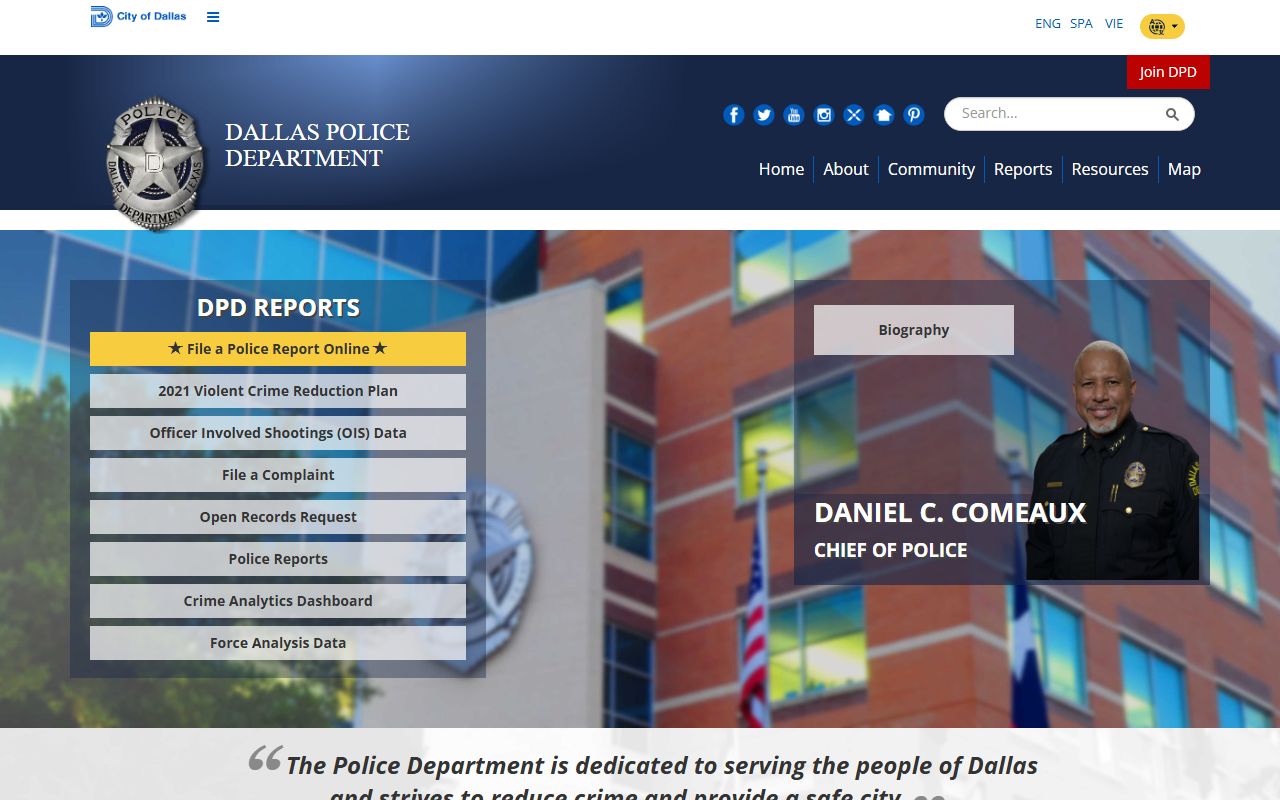
From the DPD site you can access crime data, find patrol station addresses, and get links to the open records request process for Dallas police records.
How to Get Dallas Police Reports
There are three ways to get police records from DPD. You can visit the Records Unit in person, send a written request by mail, or use the City of Dallas online portal. The method you pick depends on how soon you need the report and how far you are from the headquarters.
For in-person requests, go to 1400 S. Lamar Street and head to the Records Unit. Bring your photo ID. Give the clerk the report number, date, location, and names of the people involved. If you do not have the report number, that is fine. The date and location are enough to find most records. Standard copies cost $6.00 per report. Certified copies are $8.00. Crime victims can get one free copy after showing their ID and confirming they are listed in the report.
Mail your request to DPD Records Unit, 1400 S. Lamar Street, Dallas, TX 75215. Write down the incident date, location, names, and any report numbers you have. Include a check or money order for the fee, made payable to the City of Dallas. Allow at least two weeks for mail processing and return delivery.
The City of Dallas Open Records Center handles online requests. You can also email DPD Legal Services at policelegal@dallascityhall.com. Under the Texas Public Information Act, DPD has 10 business days to respond. No reason is required for your request. If the department plans to deny your request, they must seek a ruling from the Texas Attorney General within 10 business days.
Note: Dallas police reports take 5 to 7 business days to enter the system after an incident, so plan your request accordingly.
Dallas Police Records Fees
DPD charges standard fees for copies of police records as allowed by Texas law. The prices are the same whether you come in person or request by mail.
An incident or offense report costs $6.00 per copy. Certified copies run $8.00 each. Accident reports match those prices: $6.00 regular, $8.00 certified. Other paper copies are $0.10 per page for letter size and $0.15 for legal size. CDs or DVDs cost $1.00 per disc. For large requests needing heavy staff time, DPD can charge $15.00 per hour for labor after the first two hours, plus 20% overhead on labor costs. When the total passes $40.00, you get an itemized estimate before any work starts. State law says the first 50 pages are free if the records sit in one spot.
In person, DPD takes cash, check, money order, or credit card. By mail, they accept check or money order only. Make it payable to the City of Dallas. Victims of crimes get one free report copy upon verification.
Dallas Police Report Contents
DPD incident reports follow a standard format that captures all the key facts of a case. Each report starts with the date, time, and exact address of the incident, often including GPS coordinates. The complainant or victim section lists the person's full name, date of birth, home address, phone number, and their account of what happened.
Suspect sections include the person's name (when known), physical description, clothing, and the direction they went. If witnesses were present, their names, contact details, and statements go in the report. The officer narrative is the most detailed part. It covers what the officer saw, heard, and did from arrival to departure. It also includes the officer's conclusions about what happened. Property sections document stolen, damaged, or recovered items with full descriptions and dollar values. Vehicle info covers year, make, model, color, plate, VIN, and owner.
DPD uses Texas Penal Code sections and their own internal offense codes to classify each crime. Disposition codes tell you the current status: cleared by arrest, exceptional clearance, unfounded, or still open. Each report carries the officer's name, badge number, unit assignment, and a supervisor's approval signature. If evidence was collected at the scene, like photos, fingerprints, or DNA, that is noted in the report. Supplemental reports get filed as the investigation moves along, and you can request them with the same original report number.
Dallas Accident Reports
Crash reports filed by Dallas police follow the same state rules as the rest of Texas. DPD officers file CR-3 crash reports within 10 days of the accident, as required by Texas Transportation Code Section 550.065. All reports go into the statewide CRIS system managed by the Texas Department of Transportation.
Crash reports have a 60-day confidentiality period. After 60 days, you can purchase them from CRIS online. The fee is $6.00 for a standard copy and $8.00 for certified. You search by name, driver license number, VIN, or the TxDOT crash ID. DPD assigns an 8-digit report number at the scene, which you can also use to track the report down.
For serious injury and fatal crashes, the DPD Traffic Division handles the investigation separately. Those reports may take longer to finalize. Crashes on state highways or interstates should be requested from Texas DPS instead of DPD, since DPS officers usually respond to those.
DPD Patrol Stations in Dallas
Dallas Police operates seven patrol stations across the city. Each one covers a different zone. You can request records assistance at these stations, though the main Records Unit at headquarters handles the bulk of requests.
- Central Patrol: 334 S. Hall St - (214) 670-4411
- Northeast Patrol: 9915 E. NW Hwy - (214) 670-4415
- Northwest Patrol: 9801 Harry Hines Blvd - (214) 670-4420
- Southeast Patrol: 725 N. Jim Miller Rd - (214) 670-4425
- Southwest Patrol: 4230 W. Illinois Ave - (214) 670-4430
- South Central Patrol: 1999 E. Camp Wisdom Rd - (214) 670-4435
- North Central Patrol: 6969 McCallum Blvd - (214) 670-4440
If you are not sure which station covers your part of Dallas, call the DPD non-emergency line at (214) 744-4444. Officers at patrol stations can also take new reports and help you figure out which records you need. Each station runs 24-hour patrol service for its area of the city.
Dallas Police Records Online Tools
DPD and the City of Dallas provide several free online tools for searching police records and related data. These run around the clock.
The DPD crime statistics page shows crime trends and maps for the city. The Dallas Open Data Portal has public datasets including some police data you can download and analyze yourself. The Dallas Municipal Court portal lets you look up traffic citations and court case info. For victim notifications, VINE Link sends free custody status alerts by phone, email, or text. Register online or call 1-877-894-8463.
The Texas DPS Sex Offender Registry covers Dallas and all of Texas. You can search by name or view offenders near a specific Dallas address. Dallas Crime Stoppers takes anonymous tips at (214) 373-TIPS. The city's 311 service handles non-emergency requests and can direct you to the right office for records that do not fall under DPD. Body-worn camera footage requests go through DPD Legal Services at (214) 671-3002. 911 call recordings are handled separately by the Dallas Office of Emergency Communications.
Note: Body-worn camera and 911 recording requests each go through a different office than the Records Unit, so call ahead to make sure you reach the right team.Dallas Records Under Texas Law
The Texas Public Information Act is what gives you the right to request Dallas police records. It is in Government Code Chapter 552. The law says police records are public unless a listed exception applies. You never need to explain why you want a record. The burden is on DPD to justify any denial.
If DPD wants to withhold a record, they have 10 business days to ask the Texas Attorney General for a formal ruling. The AG then has 45 working days to decide. If you disagree with the outcome, you can take it to state district court within 30 days. The AG's open government hotline is 1-877-673-6839 for questions. Officials who intentionally hide public records face criminal penalties under the act. Standard copy fees are $0.10 per page, and the first 50 pages are free if the records are kept in one location.
Dallas County Police Records
Dallas sits in Dallas County. DPD handles police records inside the city, but the Dallas County Sheriff's Office covers the unincorporated areas and smaller towns in the county. The sheriff's office is at 133 N. Riverfront Blvd. Dallas County also runs one of the largest jail systems in Texas with a combined capacity of over 7,000 inmates. For county-level records, jail lookups, and more, visit the Dallas County page.
Nearby Cities with Police Records
The Dallas-Fort Worth area has many cities with their own police departments. If the incident you need records for happened outside Dallas city limits, one of these departments may have the report instead.
Fort Worth is the largest nearby city, about 30 miles west. Arlington is between Dallas and Fort Worth. Irving borders Dallas to the west. Garland and Mesquite are to the east. Plano, Frisco, McKinney, Allen, and Richardson are to the north. Grand Prairie and Mansfield sit to the south and southwest. Carrollton, Lewisville, Denton, and Flower Mound are to the north and northwest. Each city keeps its own records.